

“The imaginative faculty, seeking to clothe utility in ever-new forms, often evolved original units such as the sewing desks, so called, designs of which vary greatly in different societies, even within a given community.”
– Edward Deming Andrews,
Shaker Furniture (1939)
Today, the Shaker sewing desk is a classic and sought-after form. Usually comprised of a worktable over drawers with a gallery of smaller drawers above, this uniquely Shaker design represents a 50-year evolution that demonstrates the Shaker principles of creative reuse and adaptation. Built to accommodate various Sisters’ tasks, there are myriad variations on the Shaker Sewing Desk: the incorporation of pull-out, expandable work surface; additional drawers on the left or right of the lower case; pegs affixed to the apron; fold-out leaves; a gallery floating above the desk; innumerable configurations of upper drawers and cabinets; and the addition of a shallow, under-hung drawer to hold patterns.
The origin of the sewing desk is rooted in the simple worktable, developed in the early-19th century. Soon after, drawers were added to accommodate sewing accessories and tools and, by the mid-century, removable add-on galleries of multiple drawers were often constructed to rest on top of the work surface. What we now think of as the classic Shaker Sewing Desk was designed and built with an incorporated gallery of drawers, prototyped after the design of the table plus the add-on.

The iconic Shaker sewing desk form originated in Northern New England—the Canterbury and Alfred bishoprics; however, New/Mount Lebanon developed a distinctive sewing desk as well. In the History of the Shakers at New Lebanon, Brother Isaac Newton Youngs wrote: “We find out by trial what is best, and when we have found a good thing… we stick to it.” [i] Shaker design was intentional—it was purpose and person-driven, embodying the idea of every force evolves a form. If a Shaker Sister required a specific surface, storage, and orientation for a particular task, it was created for her. Objects were conceived and crafted with the utmost intention.

Many of the most outstanding examples of imbuing intention into design are illustrated by objects related to the work of women. Though Shaker communities relegated tasks along traditionally gendered lines—Brethren worked the fields, farms, mills, and workshops, Sisters handled the domestic tasks of cooking, cleaning, sewing, laundry, etc.—the two spheres supported each other and were upheld equally as contributing to the functioning and overall productivity of a Shaker community.[ii]

Historic photographs illustrate the ways that sewing desks were used by Shaker Sisters in their workshops and retiring rooms. Sisters were always kept very busy producing items for the community as well as for sale to the World. According to Andrews, “the hands of many sisters, young and old, were required to supply stockings and underclothes, shirts and collars; to mend clothes; to finish the cloth-and-leather gloves; to make seed bags; to line and furnish sewing boxes; to weave the fine ash and poplar baskets; to braid palm leaf for mats and bonnets; and to make the fans, dusters, pen wipes, cushions, spool stands and numerous other articles of handcraft so useful to a well-ordered communal life and so prized by the people of the world.” [iii]
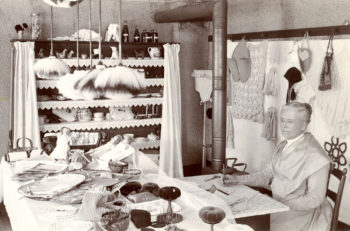
As early as 1813, Brother Isaac Newton Youngs recorded that the Sisters began “little by little to make baskets for sale,” and they quickly expanded production to include many other kinds of goods—from hats and brushes to herbs and preserved items. [iv] The first Shaker store was opened by the New Lebanon Church Family in 1827 and, by the 1830s, production of goods for sale reached significant proportions. Fancy goods or fancy work—domestic objects made by the Sisters for a predominantly female market—became an economic mainstay for the Shakers. By the 1870s, the overall ratio of women to men was roughly two to one (higher in certain communities). Brother John Vance of Alfred wrote in his journal that such male tasks as manufacturing woodenware and producing tanned goods, seed, and herbs were largely either “dropped years ago” or “destroyed” by competitors. The “only branch of manufacture in the Society,” according to Vance, was the Sisters’ fancy work. [v]
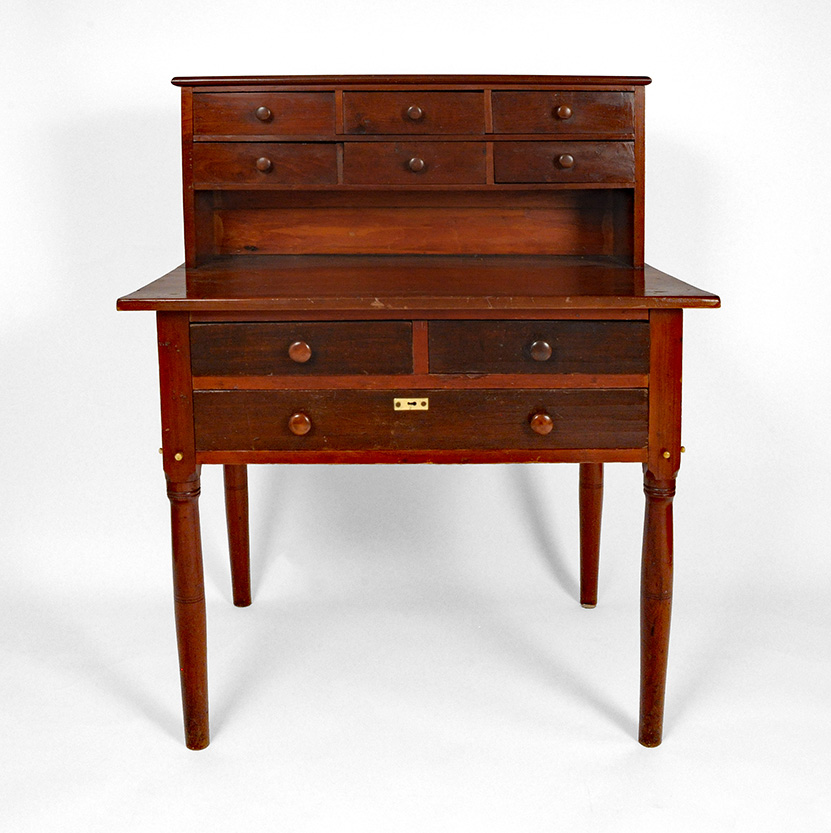

This rare Shaker Sewing Desk, which descended in a New Lebanon, NY-based family, was created in the third quarter of the 19th century when the Sisters’ economy was vital to the fiscal viability of the Shakers. Illustrated in the Encyclopedia of Shaker Furniture (2003), this piece was originally designed and constructed as a sewing desk and has never been altered. The form is relatively typical of a Mount Lebanon desk; however, it has an unusual square-to-round transition on the leg and a horizontal bone escutcheon. The bone buttons on the legs just below the perimeter of the base are thought to have held a fabric bag that hung under the desk—a feature that was popular in the Federal period.
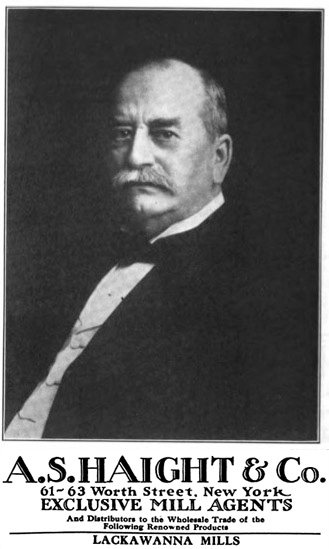
The provenance of this piece is tied to Abner Sherman Haight (1839-1920), founder of the A. S. Haight company, which specialized in wholesale distribution of knit cotton and wool long underwear. Haight was born in New Lebanon, NY, and he maintained a farm of 1,500 acres near the New Lebanon Shakers. [vi] There is documentation that Haight commissioned a Shaker Cupboard over Drawers, which was made and delivered to his home in 1853. Haight family oral history has relayed that additional pieces of furniture were commissioned to furnish his New Lebanon residence as well as his hunting cabins. Since this Desk was acquired from the Shakers at Mount Lebanon, was it one of those special commissions or was it used by the Shakers?
Upon Mr. Haight’s death, the Sewing Desk was inherited by his son, Charles Sherman Haight (1870-1938), who moved it to his home, “Unity Lodge,” in 1892. From there, it was moved to a hunting lodge also owned by Charles, before being inherited by Abner’s granddaughter, Harriet Schutt (1908-1981), who moved it to Lancaster, Pennsylvania, and then to Pasadena, California. Subsequently, the piece descended to Harriet’s son, Kenneth Haight Schutt (1934-2018), and grandson, Geoffrey Mann Schutt (b. 1963).
Overall, this Sewing Desk is in fine, original condition. It retains its original stain and varnish surface with a subsequent clear over-finish that was applied at a later date.