
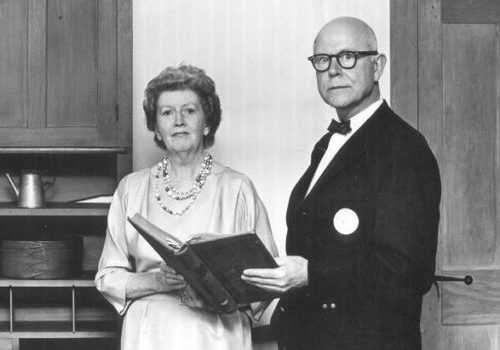
“Pandora’s box was empty compared with our first glimpse beyond the kitchen door,” reflected Faith Andrews on the first visit that she and her husband, Edward Deming Andrews, paid to the Hancock Shaker community in 1923.[i] Who would have guessed that a stop for a loaf of freshly baked bread would spark a life’s work? In their memoir, Fruits of the Shaker Tree of Life, the Andrewses recalled this fortuitous moment that led to decades of research, collecting, and curating that, ultimately, elevated the achievements of the Shakers from obscure footnote to formative touchstone within the history of American culture and design:
“A soft voiced Shaker sister welcomed us warmly. We bought two loaves of bread. And in the long clean ‘cook-room’ we saw much besides; a trestle table, benches, rocking chairs, built-in cupboards, cooking arches, all beautiful in their simplicity. Later, eating the bread, we knew that our appetite would not be satisfied by bread alone.”
– Faith Andrews interviewed by Robert F. Brown, January 14, 1982
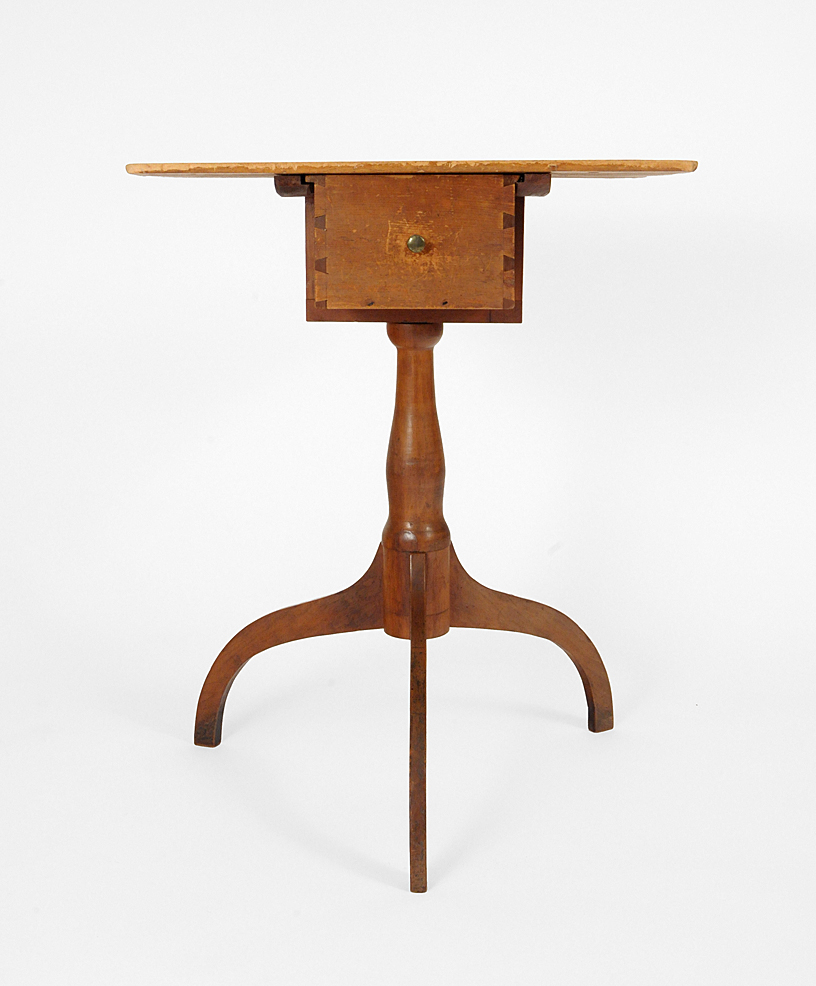
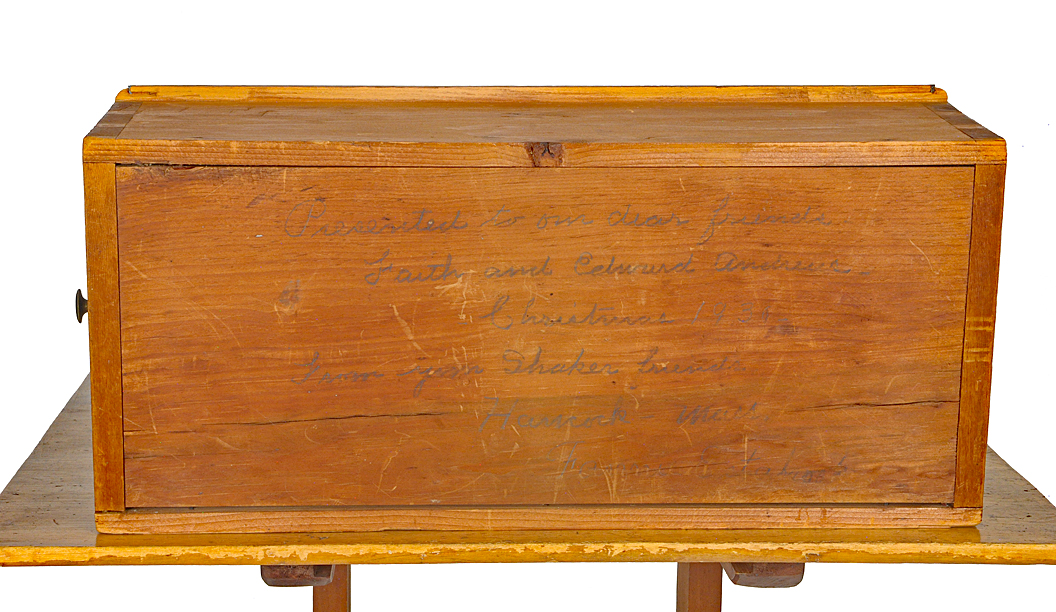
This rare, Sewing Stand was a Christmas gift to the Andrewses from the Eldress Fannie Estabrook (1870-1960) on behalf of the Hancock Shaker community. Unique to the Hancock Shakers, there are only three examples of this form known. The Andrews’ stand is a singular variation, comprised of mortised spiderlegs, a basswood top, a single under-hung drawer that can be pulled from either side, and a finely dovetailed yoke threaded into a turned cherrywood pedestal. The underside of the drawer bears an inscription:
Presented to our dear friends –
Faith and Edward Andrews
Christmas 1930
From your Shaker friends
Hancock – Mass.
Fannie Estabrook
Beginning in the 1920s, the Andrewses purchased, sold, traded, and donated thousands of objects that, today, are highlights of important public and private Shaker collections. Their ability to assemble such a diverse array of material—as well as document, publish, and exhibit its history and meaning—was largely indebted to the collaboration of the Shakers living at the time. As summer residents of Pittsfield, Massachusetts, the Andrewses were particularly close with the Shakers at Hancock, (later, they would become full-time residents of Richmond, MA—a town neighboring the village). Sister Alice Smith (1884-1935) was their first elderly Shaker friend. Most likely, it was Sister Alice who first opened the door 1923 and was their gateway to the rest of the community.
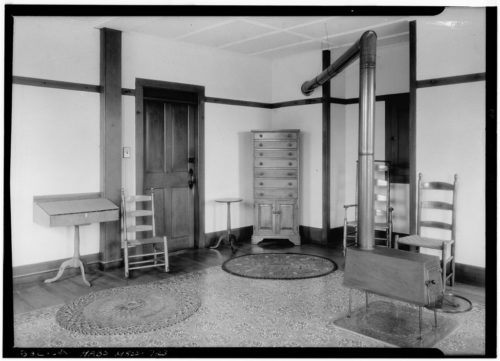
During their visits to Hancock, the Andrewses were shown rooms full of furniture no longer in use due to the community’s dwindling numbers. “Almost everything had its price,” recalled Faith in a 1982 interview.[ii] It is unclear how the availability and value of items was determined, but it is certain that Eldress Fannie Estabrook was greatly involved.
Appointed Eldress in 1929, Estabrook and Eldress Caroline Helfrich (1836-1929) oversaw Hancock’s Church Family. The Eldresses would have been obligated to report all financial decisions to Trustee M. Frances Hall (1876-1957), (who lived in the Trustees’ Office rather than the Church Family dwelling), but it is unclear if proper protocol was observed when it came to the selling of their communal possessions. As well, there is documentation and personal testimony confirming that Sister Alice was ferreting items to her friends “under the table.”[iii] She not only offered things to the Andrewses—notably a collection of gift drawings, but Alice also helped Charles C. Adams assemble a significant Shaker collection for the New York State Museum.

A group of more recent Shaker scholars have written critically about the Andrewses and their legacy. As scholars and dealers of American antiques, they are suspected of sacrificing historical integrity in service of monetizing their own collection—a collection that some see as the result of exploiting a society in decline and the elderly women at the helm. Nonetheless, the gift of this Sewing Stand is evidence of the intimate relationship between the Andrewses and the Hancock Shakers—Eldress Fannie in particular. Indeed, we owe the existence of this Stand and many of the most outstanding objects designed and made by Shaker hands to the Andrewses and their intrepid desire to imbue Shaker with the significance it deserves. The Andrewses are a part of Shaker history, and this Sewing Stand is a reminder of the profound importance of their work.
The Stand was exhibited at Hancock Shaker Village when it opened as a cultural site in July 1961, but it was removed when the Andrewses resigned in 1963—it was not included in their seminal gift to the museum. There is no record of the piece being shown outside of this two-year window—it does not appear in any documentation of the 1932 exhibition at Berkshire Museum (Pittsfield, MA) or in the 1935 exhibition at the Whitney Museum of American Art (New York). In the mid-1960s, the Sewing Stand was given to The Andrews’s daughter, Ann E. Kane, who retained it until 2006. “I have loved this item, and for many years, up to our recent move, it was prominently displayed in our living room. It has been part of our family for nearly 80 years,” remarked Ann in a letter.
In 2008, the Sewing Stand was exhibited in Gather Up the Fragments, curated by Christian Goodwillie and Mario S. de Pillis, which toured nationwide until 2017.