
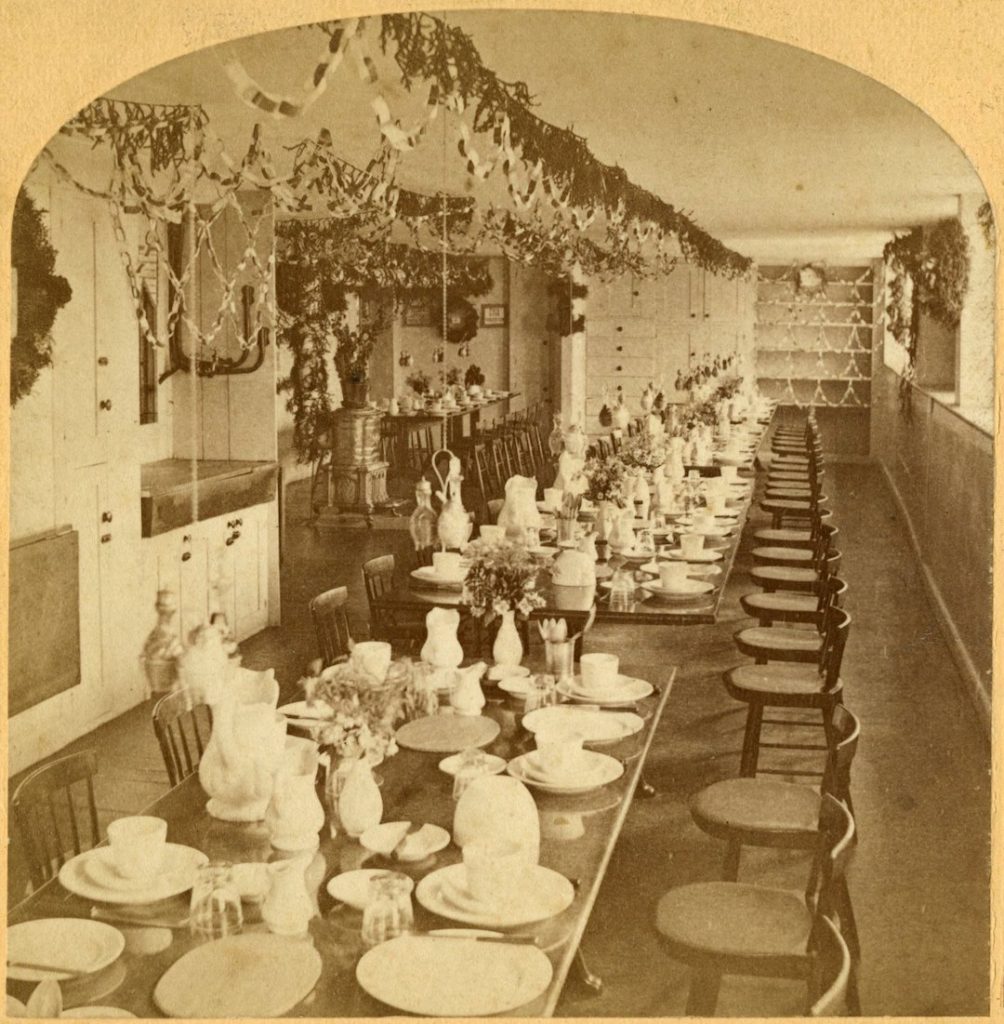
There’s no better way to build community than to share meals together. “A family is a group of people who eat the same thing for dinner,” remarked writer Nora Ephron. This is certainly true when looking at the communal lives of the Shakers, for whom mealtimes were nourishment for body and spirit.
There was a great deal of ritual surrounding Shaker families coming together to dine. Each mealtime was signaled by the toll of a bell, after which the Shakers would enter the dining room and sit with their respective genders—Brethren on one side, Sisters on the other. Beyond the clatter of filling plates with whole grains, vegetables, meat, and fresh baked bread and pie, meals transpired in silence to provide space for thanks for abundant food, good health, and a loving community.
The Shakers created monumental Trestle Tables of astounding lengths to accommodate meals for families of up to 100 Believers, who would pull up shared, backless benches to the tables to dine. According to Shaker Elder Henry Clay Blinn (1824-1905), the benches “were not convenient, especially if one was obligated to leave the table before the others were ready. All were under the necessity of sitting just so far from the table.”[1]
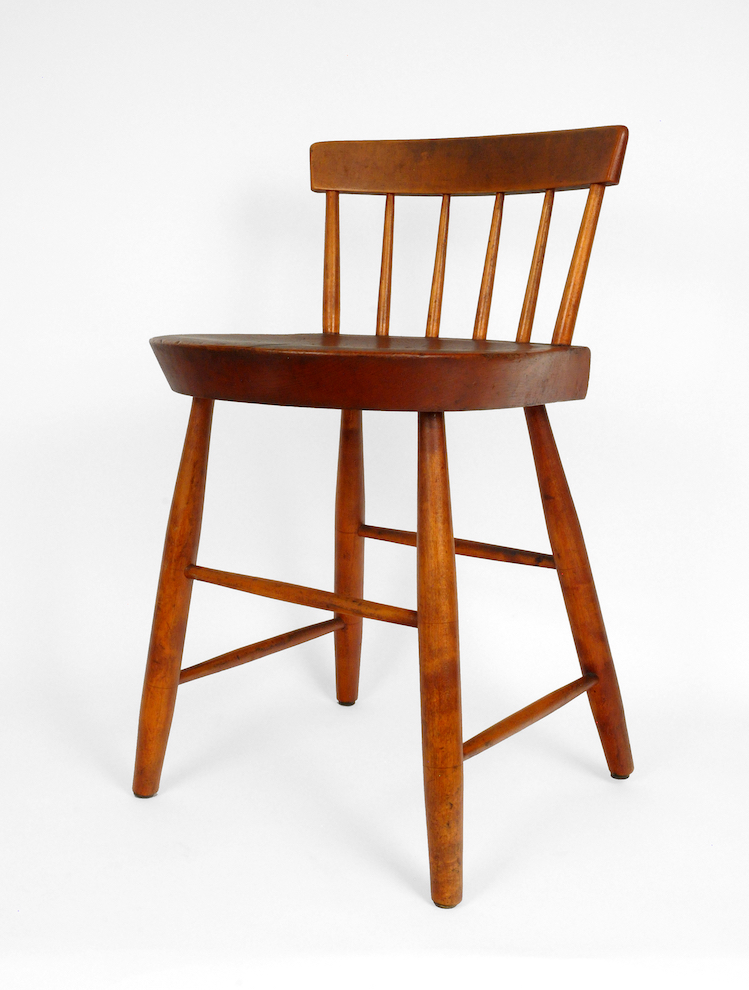
In 1834, Elder Micajah Tucker (1764-1848) of Canterbury, New Hampshire, decided to retire the communal dining benches and produce individual spindle-back dining chairs. In A Current Record of Events from 1792 to 1885, a community journal documenting happenings at the Canterbury Shaker community, it is noted on April, 26, 1834:
“Our Dining Room tables having been newly stained and a sett[sic] of new chairs made for the dining room by Elder Micajah Tucker & Bro. Joseph Sanborn we occupy them to-day for the first time”[2]
One of the early New Hampshire Believers, Elder Micajah was chosen as a Deacon at the founding of the Canterbury community in 1792. He traveled spreading the Shaker gospel as a missionary for over a decade, before settling in Canterbury full-time in 1806 and serving as an Elder for the next 28 years. Upon his retirement from the ministry, Elder Micajah, who was a joiner and carpenter by trade, turned his attention to creating dining chairs.
The design of Elder Micajah’s Dining Chairs is emblematic of Shaker ingenuity. “There is no dirt in Heaven,” proclaimed Mother Ann Lee (1736-1784). Shaker design is an aesthetic motivated by faith. Comprised of concave crest rails, spindles, shaped seats, and turned legs, the low backs of Brother Micajah’s dining chairs were designed to fit discreetly under a Shaker dining table to facilitate cleaning, setup, and storage.
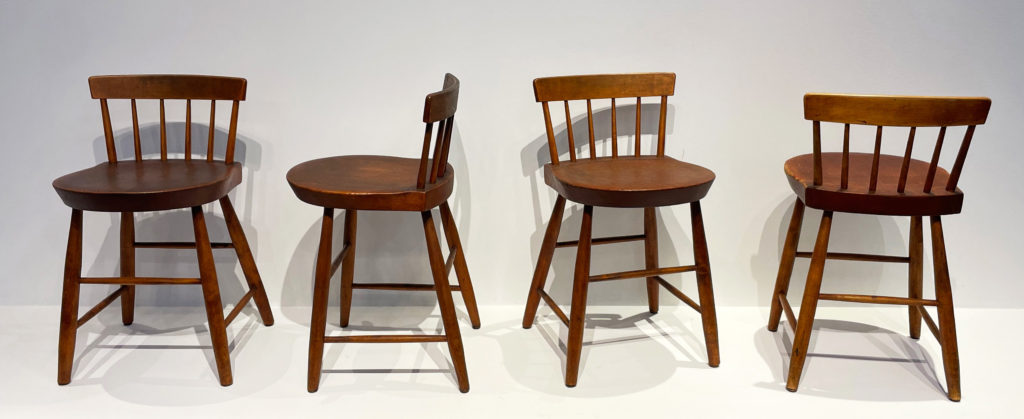
A rare and sought-after Shaker design, it is presumed that only 80-90 of these chairs were ever made. The design was influenced by the Windsor plank-bottom chair, with Elder Micajah’s version distinguished by boldly beveled seats and strongly canted legs. This set of four Dining Chairs is crafted from birch and pine, retaining their original red stain and varnish surface. On the undersides of the seats are Shaker markings in red paint: the numbers “2,” “18,” and “12.” According to Tim Rieman and Jean Burks in The Encyclopedia of Shaker Furniture (2003), “it is not known if [the numbers] represent a particular member, seat location in the dining room or other rooms in which the chairs may have been used,” (p. 415).
Regardless, the design of Elder Micajah Tucker’s dining chairs is icon within the canon of classic Shaker forms.