
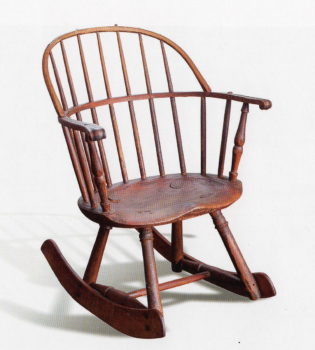
Few realize that the rocking chair is a relatively new furniture form. These days, they’re everywhere—decorating nurseries, sitting rooms, porches, airports, hotel lobbies, and even highway rest stops. Their ubiquity suggests a timelessness but, in truth, the first rocking appeared only about 250 years ago when American colonists began adding rockers to existing chairs. Before long, the swaying motion of DIY rockers proved to be relaxing and a welcome relief to tired, aching backs, and by the mid-19th century, rocking chairs were common fixtures in American homes.
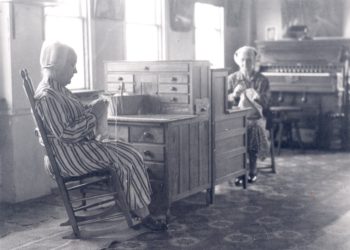
The Shakers were among the first in the US to manufacture rocking chairs for use within the community as well as for sale to the world. Since utility is at the foundation of Shaker design, we imagine that it was the therapeutic effects of rocking that led to production, (as opposed to the leisurely porch vibes that rocking chairs were associated with at that time). Too, at the turn of the 19th century, the founding generation of Shakers was aging. According to the 1845 Shaker Millennial Laws, “One rocking chair in a room is sufficient, except where the aged reside,” (section X, no. 3). Rocking chairs were seats for those further along in years—thrones for the elder and senior to pursue the spiritual work of Shakerism in comfort.
The earliest rocking chairs made by the New Lebanon Shakers are dated to the opening decade of the 19th century—the time when Shaker communities were in the process of being designed, built, and furnished. Within the spectrum of Shaker material culture more broadly—from architecture to furniture and handheld tool—there was a spirit of experimentation as designs were prototyped, formalized, and disseminated amongst all of Shaker society. This iterative process can be observed in the rocking chair which, over a century, evolved from a bespoke object made for an individual Elder or Eldress to a standardized template manufactured in eight sizes.
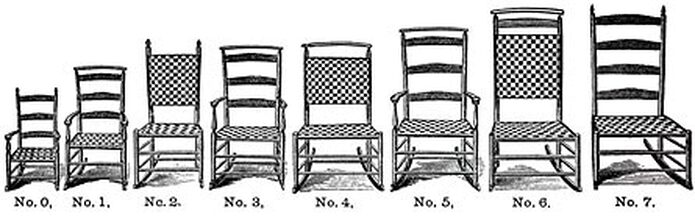
Throughout the 19th century, the Shakers of New Lebanon finetuned the rocking chair form and streamlined production. The chairs became lighter, more refined, and balanced in their proportions. Over time, technology changed as well—new tools and techniques such as water-powered lathes, steam-bending, and the advent of the circular saw allowed the Shakers to create more ergonomic chairs with greater efficiency and a reduction in handwork.
Of course, the tailored nature of Shaker furniture made for community use combined with the unique experimentations of individual turners, (or chairmakers), have resulted in myriad variations—there is no truly “iconic” New Lebanon Shaker rocking chair. Piecing together a cohesive trajectory of rocking chair design proves challenging; however, the material record existent today provides some compelling case studies for examining pre-production rocking chairs—their underlying principles, fabrication process, and presumed purpose.
In general, the rocking chairs made at New Lebanon can be divided into five phases:
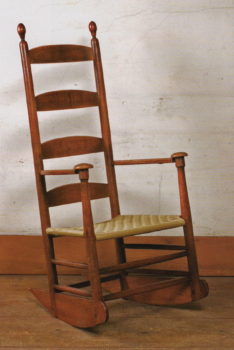
· Early, 1790s-1820s. Early Shaker rocking chairs exhibit a charming crudeness—they tend to be physically heavy and ofttimes visually awkward.

· Classical, 1820s-1850s, the period of greatest creativity. Classical chairs express the Shaker ideology of simplicity, utility, and beauty—they become lighter, more visually balanced, and exceptionally crafted by hand. It is presumed that the majority of these chairs were created for community use. With variations in arm placement, seat height, and the position of slats, this bespoke method of production indicates that individual chairs were made to the specifications of individual Shakers.
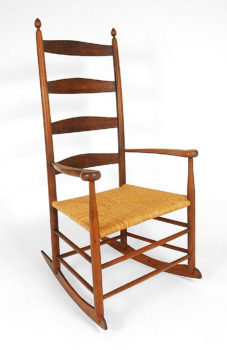
· Transitional (Early-Production), 1850s-1874. Until 1863, the chair industry was managed by the New Lebanon Second Family, which operated the chair factory six months per year, employed three people, and had an annual production of approximately 600 chairs.[i] After 1863, production was overseen by Elder Robert M. Wagan (1833-1883) of the South Family. During this Transitional period, chairs were mostly crafted by hand, which retained subtle variations and imperfections, and a system of labeling chairs by size was introduced.
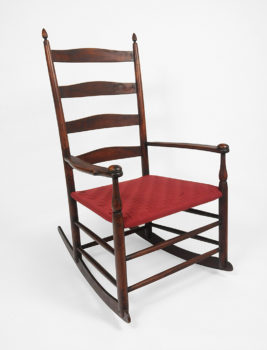
· Wagan Era (Peak-Production), 1874-1923. Elder Robert M. Wagan oversaw the transition to the standardization of Shaker chairs, offered in eight sizes and a selection of styles, as well as the complete mechanization of the fabrication process, which relied on standardized components. In 1874, Wagan introduced a trademark decal, authenticating the South Family chairs as Shaker.
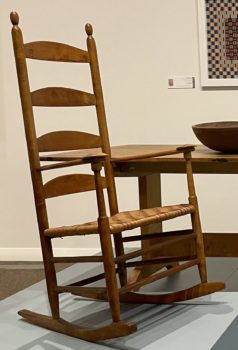
· Perkins-Barlow Era (Late-Production), 1923-1940. In 1915, Brother William Perkins (1861-1934) took over the management of the South Family chair factory. With Sister Lillian Barlow (1876-1942), they oversaw operations through a devastating fire in 1923. When the chair factory was reopened, changes in staff and equipment resulted in modifications in the design and fabrication of the last Shaker chairs.
The intent of this blog entry is to delve into the Classical period of Shaker rocking chairs, examining three examples of rockers produced between the 1820s and 1850s. (Please note: none of these chairs are in available inventory! Contact us directly to discuss what we currently have to offer.)
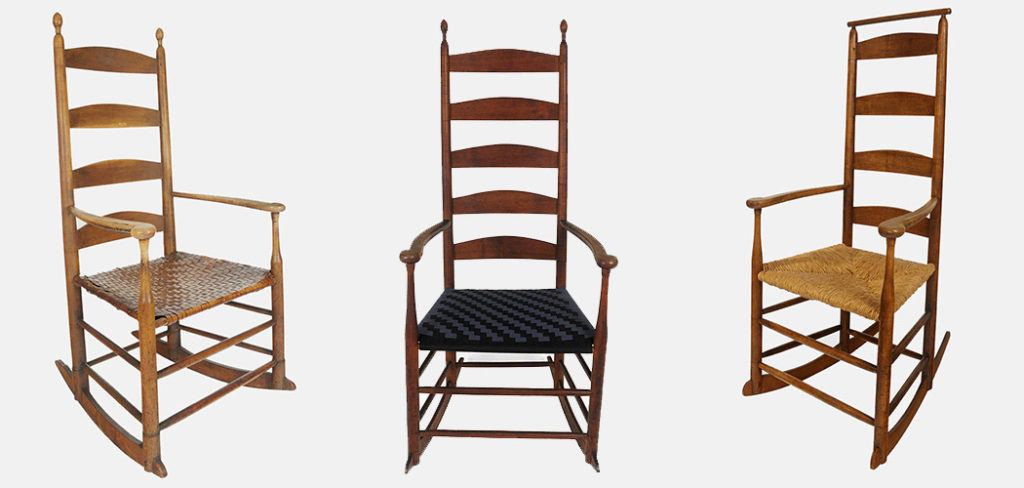
The first, affectionately nicknamed “Boots,” came to us via the Robert & Hazel Belfit Shaker Collection, which was presented at the Antiques in Manchester fair in August 2022.
The second, “Five Slat,” is a monumental Elder’s chair in its original red stain that came back through the shop recently because it needed a new taped seat.
The third, “Cindy’s Chair,” (named for its owner, Cindy Russell, who received it from John as a wedding present), is an elegant Eldress’ chair with the rare feature of a cushion rail, (also called a shawl bar), in lieu of finials.
These three chairs are exceptional examples of Classic New Lebanon rocking chairs made between the 1820s and 1850s—the center of the overall iterative arc of the form, when Shaker design and craft reached its peak. What’s interesting is that certain elements of the chairs might date them earlier, while other details indicate a later date of manufacture. It’s this remixing of features that leads us to date these examples within the Classical period—we cannot definitively say which pre-dates the other, (although we can argue about it at length!).
Let’s begin by examining the chairs’ similarities. The three chairs have:
-
- rocker blades of a thicker weight (when compared to later production chairs) and distinctive shape—pointed front, concave between posts, and a shaped blade end.
-
- posts fitted around the rocker blades that are squared off on the bottom edge and secured with wooden pins (Five Slat and Cindy’s Chair) or ferrous screws (Boots).
-
- front posts with a concave taper from seat to arm ending with a turned collar that is mortised into the underside of the circular handholds.
-
- side scroll arms that are rounded on the inside, beveled on the outside, and tenoned into the rear posts.
-
- non-graduated, beveled back slats.
-
- slightly tapered, straight back posts (approx. ½” graduation from bottom to top)
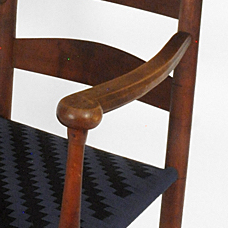
Overall, there is an undeniable refinement that has happened between Early rockers, which look like armchairs fitted with flat pontoons, and these lighter, more graceful chairs. The delicate arc of the scroll arm tenoned into the back post is a particularly distinctive feature, which gets further and further refined into the early 1870s (before the transition to the Wagan Era cut arm). Interestingly, it is what distinguishes these chairs from each other that makes them truly Classic Shaker rocking chairs. Created as community furniture, these examples are virtually one-of-a-kind—bespoke creations that were Shaker-made and presumably Shaker-used.
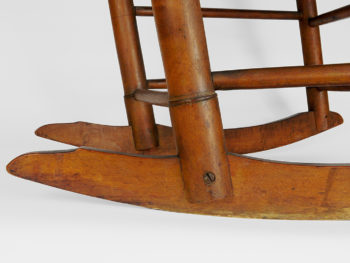
For example, Boot’s boots are the enlarged turnings at the base of the posts that provide added strength to the joint between the rockers and the post. Perhaps a more robust chair made for a weighty Shaker, this feature is most often dated to 1830s and 40s. Our best guess is that the boots proved to be a case of over-engineering, added girth that proved structurally unnecessary and was eventually eliminated from the design. It’s worth noting that Boots was made for and remained within the New/Mount Lebanon community until it was acquired by Robert and Hazel Belfit in the early 20th century. This was a well-used chair—a solid chair of sturdy design and construction that withstood generations of use.
Five Slat is a rare, statuesque design most likely created for a very tall Shaker. Well-proportioned and refined, Five Slat is visually the most successful of these three, representing the aesthetic apex of a New Lebanon Classical chair. Seen only on a small group of chairs known, the illusive fifth slat is a highly sought-after variation. Could this chair be an exercise in vanity, demonstrating either the turner’s skill or the spiritual stature of the user? Why aren’t there more five slats existent today? We speculate it may have something to do with the technical requirements to make such lengthy back posts. Lathes were not infinite in their capabilities—the additional six inches to accommodate a fifth back slat could only be achieved by a skillful maker working on a lengthy lathe.[ii]
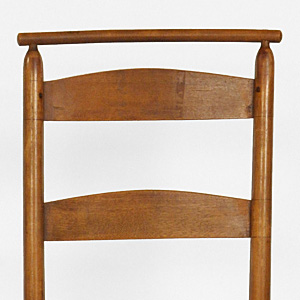
Cindy’s Chair, with its rare cushion rail, is one of only three examples with this feature known. During the Wagan Era, the cushion rail was embraced as an available variation in the Mount Lebanon chair catalog, which promoted substituting a bar across the back posts so a cushion could be hung vertically down the back slats. The Shakers would make these cushions as well, advertising, “the heavy wool plush with which we cushion our chairs is a material particularly our own. It is made of the best stock and woven in hand looms… We have all the most desirable and pretty colors represented in our cushions, and they can be all one color, or have a different color border, or with different colored stripes running across the cushion.”
What was an established product in 1874, decades prior, was a mere prototype. Of the three rockers discussed here, Cindy’s Chair is perhaps the best example of a Mount Lebanon pre-production chair, most likely made towards the end of the Classical period. We opine that the cushion rail proved to be such a utilitarian and desirable feature that it was carried through Transitional period and into production.
We will delve into the history of Transitional Rocking Chairs in a future blog post. Sign up for our e-newsletter to receive updates on the blog, events, and featured inventory.