There is a certain unpredictability that accompanies dealing in Shaker. We never know the materials that may come our way through a referral, email inquiry, or auction listing. Over the past forty-some years, John has learned to stay open and responsive—always expecting the unexpected. The capricious nature of the business is a source of both delight and frustration. When we’re looking for tables, you can guarantee we’ll find only chairs. Year-to-year flows of Shaker materials have curious peaks and ebbs, and it’s best not to commit yourself to predictions or assertions as, chances are, someone has made other plans.
In the curious spirit of the antiques world, 2023 has seen a great quantity of excellent Shaker boxes come into our South Salem shop. In late July, our inventory surpassed over 75 Shaker oval boxes. This included the Watt & Jan White Collection, an unrivaled grouping of more than 40 painted Oval Storage Boxes presented at Antiques in Manchester. This followed a three-day box-stravaganza at Enfield Shaker Museum’s annual Shaker Collectors’ Weekend, where participants dove into the minutiae of oval, dovetailed, and seed boxes with a fantastic roster of presenters including Jerry Grant, Christian Becksvoort, Erika Sanchez Goodwillie, Alexandra A. Kirtley, Tom Queen, and others.
Now in December, we’ve recently acquired a truly unique example of a Shaker oval box that we’re eager to share here: what we believe to be perhaps the only Oval Storage Box positively attributed to the Harvard, Massachusetts, Shaker community.
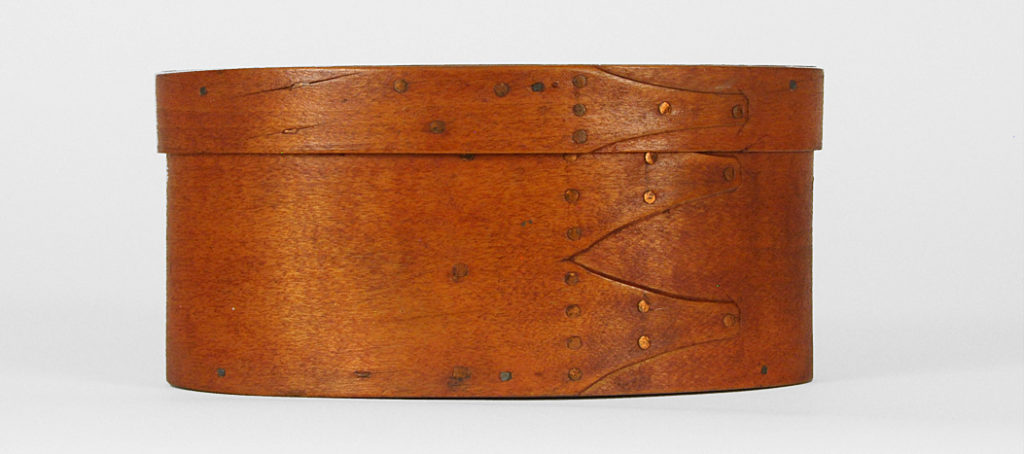
This box is of classic construction measuring 5 ½ inches across with a pine top and bottom, maple bentwood sides, and copper rivets and brads. Compared with other boxes made by other Shaker communities, the tack pattern is a bit excessive with seven tacks fixing each of the lappers on the base in a four-two-one pattern. File marks can be seen on the surface of the copper—a characteristic shared by oval boxes of the New Hampshire Bishopric, and visible scribe lines run vertically connecting the lines of tacks.
Originally, the box was finished in a pale red wash that has aged to appear like a natural stain and varnish surface. The fingers of the box, which appear to have been traced and cut using a mold, are clipped at the very end in 45-degree angles at the top and bottom to create a rounded effect. The marks from the maker’s blade are still visible in six clumsy bevels—not a common decorative embellishment, but not an unprecedented decision either.
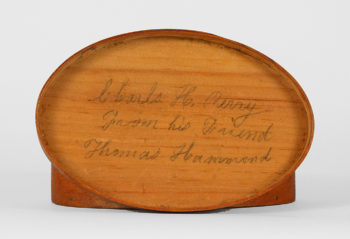
Perhaps most compelling is an inscription in graphite on the interior of the lid that reads:
Charls [sic] H. Perry
From his Friend
Thomas Hammond
The Harvard Shaker community is not known to be an oval box-producing branch of the Society. Unlike New Lebanon, Canterbury, and Alfred, they did not cultivate an oval box industry, but that does not mean they did not make boxes for community use. Elder Thomas Hammond, Jr. (1791-1880), listed as a “carpenter” in federal census data, is best known for his joinery and overseeing the production of chairs for the Harvard community. In Shaker Furniture Makers (1989), the authors note a selection of journal entries documenting Brother Thomas’ chairmaking, highlighting a January 1839 notation that states, “Elder Brother Thomas Hammond… has made all the chairs for many years.” In 1841-42, he served as foreman, producing a total of 339 chairs: “There was put at the office (for sale) 83 common, 3 rocking chairs with arms, and six small ones—92 in all.”
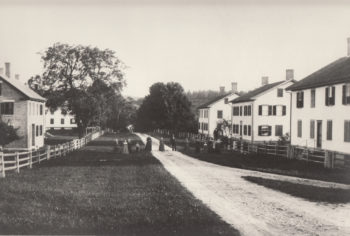
Although Elder Thomas’ activities as a church leader and farmer are well documented in manuscripts in the collection of Fruitlands/The Trustees, (he compiled numerous daybooks), very little documents his activities in cabinetry. The only entry that opens up the possibility of Elder Thomas’ involvement in oval box production is through a record of his work in an adjacent craft: bentwood sieves. On December 15, 1849, Elder Thomas hauled maple logs to the mill for sieve rims and he worked at the mill planning sieve rims with his new machine. This planning machine could also have been used to produce the maple sides and rims of oval pantry boxes.
Journals in the collection of Western Reserve Historical Society (WRHS) written by Elder Joseph Hammond (1789-1849), Elder Thomas’s biological brother, also contain many references to the sieve industry at Harvard. Intermittently throughout 1826 and 1827, he documents his progress making and finishing sieves, alluding to the production of oval boxes as well. Notably, Elder Joseph documents:
1826 jul 11: Wrought at shaving down the laps of 6 Doz wide rims for Large sieves… finished oval molds.
1827 apr 30: Wrought made 2 small oval sieve rims & made 2 small Oval Box Sieves & got out & cut in the headings & finished & carried to the office about 10 Oclock P.M. 3 Large Oval Apothecaries Sieves for Hosea W[inchester]. These are the last of 10 Sieves I have now made.
1827 dec 12: Wrought at plaining, bending, & nailing 12 rims for Boxes to keep copper & Iron tacks in.
1827 dec 15: Wrought finished Boxes & numbered them.